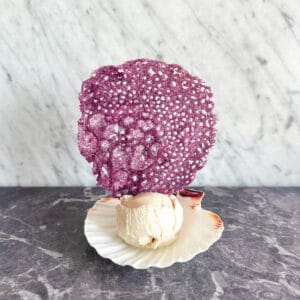
How To Make An Edible Coral Tuile Garnish
Make a beautiful coral tuile garnish to elevate your dishes and make them stand out.
Ingredients
- 40 g (⅓ cup) Cornstarch (cornflour) or pastry flour, or pasta flour
- 100 ml (⅖ cup) Water
- 100 ml (⅖ cup) Oil
- ½ teaspoon (0.5 teaspoon) Food coloring (powdered)
Instructions
- Measure and weigh the water, oil, food coloring, and flour together into a squeeze bottle or jug and shake/whisk them together until the mixture has fully emulsified.
- Place a nonstick pan over medium-high heat, and once hot, pour the coral tuile mixture into it to just cover the whole base or in smaller circles.
- The mixture will sizzle aggressively as the water evaporates away and the flour cooks in the oil. Once the lace tuile has formed, the liquid has cooked off, and the edges are curling up at the edges; gently prise it away from the pan using a silicon spatula or palette knife. Remove them to a paper towel-lined plate before starting the next one.
Notes
Ingredient notes
Read the post above for notes on the best flour to use, and how to add flavor using herbs and spices.
Equipment notes
It is essential to use a flat, non-stick pan with good heat distribution. Don't use an immersion blender to mix the ingredients as this can add too much air.
Technique notes
It might take a few goes to get the cooking method right, as all stoves will vary. If your pan is too hot, the tuile will burn. If it is too cold, the water won't evaporate fast enough and it will not crisp up.
You want the mixture to hit the pan at speed so that it spreads out and forms a very thin layer. If you are using a squeeze bottle, squeeze it quite hard to emit the liquid. If pouring from a jug or measuring cylinder, pour it from around a foot above the pan to get a gravity assist.
Storage
Store coral tuile in an airtight container and add a silica gel sachet to help keep them crisp. Use within one week.
Nutrition
Calories: 57kcalCarbohydrates: 4gProtein: 0.01gFat: 5gSaturated Fat: 0.3gPolyunsaturated Fat: 1gMonounsaturated Fat: 3gTrans Fat: 0.02gSodium: 1mgPotassium: 0.1mgFiber: 0.04gCalcium: 0.4mgIron: 0.02mg
Tried this recipe?Let us know how it was!
